The landscape of B2B software procurement is undergoing a seismic shift as traditional search engines evolve into generative AI-powered research assistants. When a prospective client asks ChatGPT, Perplexity, or Google’s AI Overviews for the "best LMS for mid-sized healthcare compliance training," the resulting response acts as a digital gatekeeper. Platforms that appear in these curated, conversational summaries gain immediate credibility and a significant competitive advantage. Conversely, many established Learning Management System (LMS) vendors find themselves inexplicably absent from these high-intent conversations, despite maintaining robust SEO strategies and healthy organic traffic rankings. This phenomenon, often referred to as a "visibility gap" in Generative Engine Optimization (GEO), is forcing a wholesale re-evaluation of how software companies manage their digital footprints.
The transition from keyword-based search to AI-assisted discovery represents the most significant change in digital marketing since the rise of search engine optimization in the early 2000s. In the traditional model, a vendor needed to rank for a specific keyword to capture traffic. In the new AI-centric paradigm, vendors must instead become an authoritative source of truth that large language models (LLMs) can confidently synthesize, cite, and recommend.
The Anatomy of the AI Visibility Gap
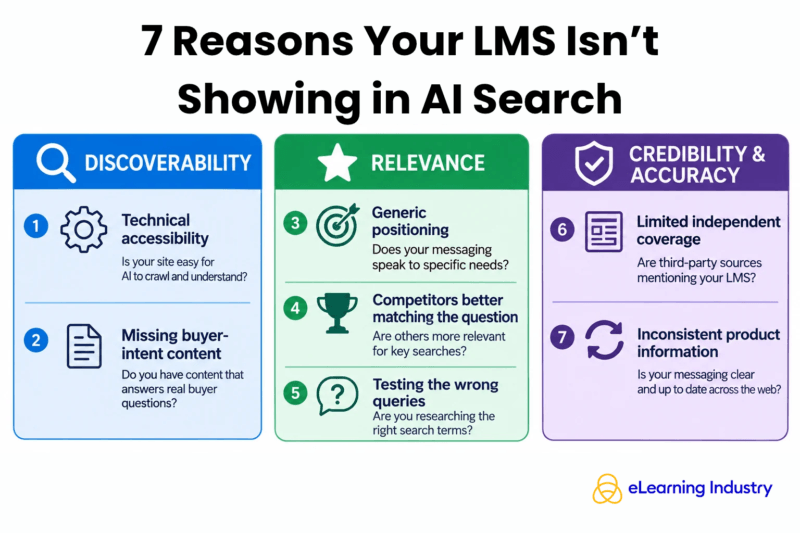
The inability of a platform to appear in AI search results is rarely the result of a single technical failure. Instead, it is usually a combination of information architecture, brand positioning, and the quality of external validation. Current industry data suggests that LLMs prioritize "entity-dense" content—pages that clearly define the relationship between a software’s capabilities, the specific industry it serves, and the concrete business problems it solves.
When an LMS website relies on generic marketing jargon, such as "a comprehensive solution for modern learning," it fails to provide the AI with the granular data necessary to answer specific buyer queries. AI models prioritize precision. If a competitor describes their product as "a HIPAA-compliant LMS with automated certification tracking for healthcare providers," the AI can easily map that description to a user’s query. The vendor using broad, aspirational language remains invisible because the model cannot verify its suitability for the specific use case requested.
A Chronology of the Search Shift
The rise of AI visibility concerns began in earnest in early 2023 with the public integration of LLMs into search interfaces. By mid-2024, the industry observed a clear bifurcation in search behavior: "informational" queries remained the domain of traditional blue-link results, while "transactional" and "evaluative" queries—the type that lead to software purchases—shifted toward AI summaries.

By late 2024, enterprise software vendors began reporting a measurable decline in referral traffic from traditional search engines, coinciding with the deployment of Google’s AI Overviews. This forced a strategic pivot. Marketing teams that had spent years refining meta-tags and backlink profiles found that their efforts were not translating into AI recommendations. The current phase, beginning in 2025, is defined by the professionalization of Generative Engine Optimization, where vendors are actively auditing their presence not just on Google, but across multiple LLM environments.
The Five Pillars of AI-Ready LMS Content
To bridge the visibility gap, industry analysts recommend a five-pillar framework that moves beyond traditional SEO metrics.
- Specific Positioning: Vendors must transition from broad value propositions to use-case-specific language. This involves creating dedicated landing pages for niche sectors, such as manufacturing, retail, or regulated healthcare, which detail specific features like integration with payroll systems or offline mobile learning.
- Entity Consistency: An LMS brand must be consistent across the web. If a company describes itself as an "enterprise training suite" on its own site but appears as a "basic authoring tool" on a software directory, the AI’s confidence score in that entity drops. Synchronizing product descriptions across third-party directories and review sites is essential for establishing "brand truth."
- Evidence-Based Content: Modern LLMs are trained to prioritize consensus and credible third-party validation. Content that includes peer-reviewed research, verified customer case studies with ROI metrics, and independent expert analysis is significantly more likely to be cited in an AI summary than pure promotional copy.
- Technical Accessibility: While LLMs are sophisticated, they still rely on the crawlability of the underlying web. Ensuring that product information is not buried in complex JavaScript, PDF-only documents, or gated content is vital. If the AI cannot "read" the feature list, it cannot recommend the product.
- Continuous Measurement: Unlike static SEO, where a ranking might hold for months, AI visibility is dynamic. A vendor’s standing can change based on the latest training data updates or new content published by competitors. Regular, automated audits of AI responses are now a standard requirement for competitive intelligence.
Industry Implications and Strategic Responses
The shift toward AI-assisted procurement has prompted a wave of reaction from industry stakeholders. Many LMS providers are now investing in "Brand Authority" programs, focusing on earning mentions in reputable industry publications and high-traffic software comparison directories. The logic is that by increasing the frequency of neutral, authoritative mentions, a vendor increases the probability that an LLM will include them in a recommended shortlist.
Furthermore, the role of customer reviews has changed. Historically, reviews were seen as a tool for social proof to influence human buyers. Today, they serve a dual purpose: they act as data points for AI models. A collection of detailed, specific reviews that highlight the same strengths—for example, "best-in-class reporting for mid-sized firms"—provides the training data necessary for an AI to associate the brand with those specific attributes.
Analyzing the Competitive Landscape
The most successful vendors in this new era are those who stop viewing competitors as mere rivals for ad spend and start viewing them as entities with whom they are being compared in the AI’s "latent space." If a competitor consistently appears in AI recommendations for "customer education platforms," a vendor should analyze the underlying content of that competitor. Often, the difference lies not in the quality of the software itself, but in the structural clarity of the documentation and the depth of the use-case-specific content provided on their website.
For example, a vendor might find that a competitor has published a series of "Integration Guides" for common CRM software like Salesforce. When a user asks an AI about "LMS with Salesforce integration," the AI identifies the competitor as the expert. The vendor who lacks such technical documentation will remain invisible, regardless of how superior their actual product might be.
Broader Economic Impacts
The economic implications for the LMS market are significant. We are witnessing a consolidation of influence. If AI models begin to consistently recommend a small subset of vendors, those companies will capture a disproportionate share of the market, creating a "winner-takes-most" environment in the digital funnel.
Conversely, this shift offers a unique opportunity for specialized vendors. A niche LMS provider that dominates a specific vertical, such as "LMS for aviation safety training," can effectively "own" the AI conversation for that segment. By focusing on depth rather than breadth, smaller players can achieve higher visibility than massive, general-purpose platforms that struggle to provide the granular detail an AI requires for high-relevance matches.
Looking Ahead
As AI models become more integrated into daily business workflows, the definition of "being online" will shift from having a website to being an integrated part of the global knowledge graph. For LMS vendors, the message is clear: the era of keyword stuffing is dead. The era of entity authority has arrived.
The vendors that will thrive in the coming years are those that treat their digital information as a structured asset, designed to be understood by both humans and machines. By prioritizing clarity, consistency, and verifiable evidence, LMS companies can ensure that when the next potential customer asks an AI for the perfect training partner, their brand is not just mentioned, but recommended. The path forward requires a transition from passive marketing to active, systematic construction of the brand’s digital identity—a process that demands precision, technical rigor, and a deep understanding of the evolving mechanics of artificial intelligence.