The rapid diversification of digital content has forced Learning and Development (L&D) professionals to re-evaluate how workplace training is delivered. While the choice between a podcast, a blog post, or a video may seem like a matter of creative preference, the decision carries significant weight regarding knowledge retention, accessibility, and operational efficiency. Moving beyond the aesthetic appeal of a medium, modern L&D strategy now emphasizes a data-driven approach that aligns specific instructional goals with the most effective delivery format.
The Evolution of Workplace Learning Formats
For decades, the standard for corporate training was the static, text-based manual or the synchronous in-person seminar. The digital transformation of the 2010s introduced on-demand learning, shifting the focus toward asynchronous content. According to industry analysis, organizations that prioritize multi-modal learning environments report higher engagement rates, as employees possess different cognitive preferences for processing information.
The chronological shift in how these media are utilized reflects broader technological trends. Blogs became the primary vehicle for internal documentation and policy communication in the early 2000s due to their searchability. As mobile technology proliferated, podcasts emerged as a convenient, "screen-free" way for employees to consume expert insights during commutes or downtime. Finally, the ubiquity of high-bandwidth internet turned video into the gold standard for behavioral modeling and software training. However, the current consensus among instructional designers is that no single format holds supremacy. Instead, the "best" format is a direct byproduct of the specific learning objective.
Cognitive Load and Medium Selection
The efficacy of a learning format is often measured by how well it minimizes extraneous cognitive load—the effort required to process information that does not contribute to the learning goal.
- Podcasts for Reflection: Audio content is uniquely suited for narrative-driven learning. When the objective is to explore complex leadership dilemmas or organizational culture, the human voice adds a layer of emotional context that text often lacks. Research, such as the 2020 randomized trial of emergency medicine trainees, suggests that audio-based learning can be highly effective if paired with active recall techniques. The trial found that trainees who were prompted with questions during or after audio modules demonstrated significantly higher retention rates than those who listened passively.
- Blogs for Precision: Text remains the most efficient medium for "just-in-time" learning. When an employee needs to troubleshoot a software issue or verify a company policy, a searchable, structured article is superior to a linear video or audio file. Data from the University of Maryland indicates that while audio and text perform similarly in terms of basic recall, text is vastly more effective at helping learners identify core concepts and find specific data points within a large body of information.
- Video for Behavioral Modeling: Video is unrivaled when the learning objective involves procedural movement or social interaction. Watching a video of a manager navigating a difficult conversation provides visual cues—such as body language, tone, and timing—that a transcript cannot capture. However, passive viewing is a common pitfall. Studies, including experiments involving university students, show that "active video learning"—which includes embedded memory checks and pauses for reflection—significantly reduces mind-wandering compared to continuous, passive playback.
A Seven-Factor Framework for Implementation
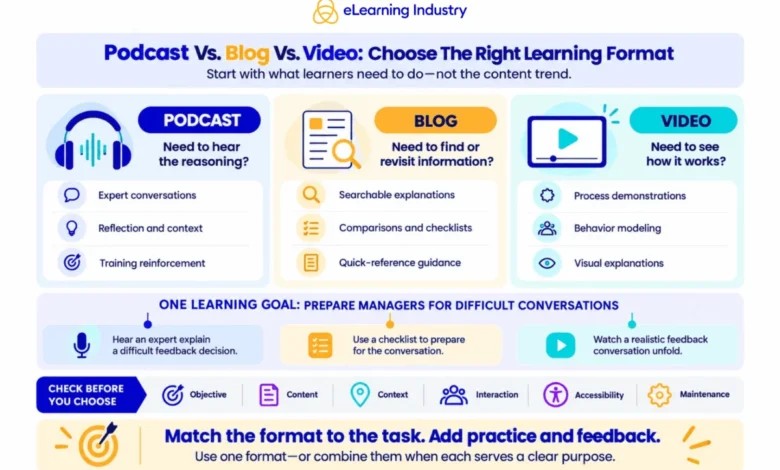
L&D leaders looking to optimize their content strategy should apply a rigorous seven-factor framework before committing resources to a specific production path. This framework ensures that the investment in content creation yields a measurable return on investment (ROI).
- Objective Alignment: Define the desired behavior. Is the goal recall, application, or conceptual understanding? Procedural tasks demand video; reference tasks demand text; conceptual growth often benefits from audio.
- Content Complexity: Assess whether the material requires visual diagrams or interfaces. If the learner must visualize a specific software menu, audio-only content will fail to provide the necessary support.
- Context of Consumption: Consider the employee’s environment. A worker in a noisy manufacturing facility requires different tools than a desk-based employee.
- Interaction Design: Learning does not stop at the "play" or "read" button. The most successful organizations integrate quizzes, reflections, and peer discussions around the core content.
- Accessibility Compliance: All content must be accessible. For podcasts, this means high-quality, timestamped transcripts; for video, it requires professional captions and, where necessary, audio descriptions for visual-only content.
- Lifecycle Maintenance: Text is the easiest to update as company policies change. Video and audio require re-recording, editing, and re-captioning, which can be prohibitively expensive if the subject matter is prone to frequent updates.
- Budgetary Realities: The cost of production should not dictate the format. A high-production-value video that fails to teach the objective is a waste of capital. Conversely, a well-structured, written guide can sometimes provide more value than a poorly produced, high-budget video.
Strategic Integration: Moving Beyond the "Or"
The most sophisticated L&D departments have moved beyond the "podcast versus blog" binary, opting instead for a "content ecosystem" approach. In this model, different formats serve different stages of the learning journey.
For instance, an organization rolling out a new leadership development initiative might utilize a podcast episode to introduce the "why" behind the change, providing emotional resonance. They would then follow up with a series of concise, searchable blog posts that serve as "how-to" references for specific scenarios. Finally, they might deploy short, scenario-based videos that allow managers to observe and critique effective versus ineffective feedback techniques.
This integrated approach solves the common problem of "information fragmentation." When resources are grouped logically within a Learning Management System (LMS)—using consistent tagging, clear titling, and logical categorization—employees spend less time searching for information and more time applying it.
The Role of Data in Future-Proofing Learning
The debate over media format will continue to evolve as new technologies, such as generative AI, change how content is generated and accessed. However, the foundational principle remains the same: the medium is a servant to the message.
Industry leaders are increasingly relying on data analytics to track how content is actually used. By monitoring metrics such as completion rates, search queries within an LMS, and performance on follow-up assessments, organizations can shift away from guesswork. If data shows that employees are dropping off from a long-form video after three minutes, the L&D team should look to replace that segment with a more concise text-based job aid or a series of shorter, modular video clips.
Implications for the Modern Workforce
The shift toward flexible, multi-modal learning is not merely a trend; it is a response to the information overload of the modern workplace. By matching the medium to the specific cognitive demands of the task, organizations can empower employees to learn more effectively.
Ultimately, the goal of an L&D strategy is to provide support that is frictionless and targeted. Whether through the reflective power of a podcast, the clarity of a well-written article, or the visual demonstration provided by video, the focus must remain on the learner’s ability to successfully acquire and apply new knowledge. In the competition for employee attention, the most successful formats are those that respect the learner’s time and provide immediate, actionable value. As the workplace continues to evolve, those who treat content design as a strategic, evidence-based discipline will be the best positioned to foster a culture of continuous growth and operational excellence.