The Socratic Method represents a foundational shift in pedagogy and corporate training, moving away from the traditional "sage on the stage" model toward a collaborative, inquiry-based exchange. By prioritizing rigorous questioning over the delivery of direct information, this technique fosters critical thinking, intellectual humility, and cognitive agility. Originating in the philosophical dialogues of Socrates in 5th-century BCE Athens, the method was famously documented by his student, Plato. Unlike the sophists of his time, who charged fees to provide ready-made arguments and rhetorical shortcuts, Socrates claimed to possess no wisdom of his own. Instead, he employed the elenchus—a process of cross-examination—to expose the contradictions in his interlocutors’ beliefs, thereby clearing the ground for a more truthful understanding.
Historical Context and Philosophical Evolution
The evolution of the Socratic Method spans over two millennia. In the classical era, the objective was the pursuit of "truth" and moral clarity. Socrates believed that by asking a series of probing questions, he could assist his dialogue partners in "birthing" knowledge that was already present within them but obscured by unexamined assumptions. This approach laid the groundwork for the scientific method, emphasizing the importance of hypothesis testing and evidence-based reasoning.
Throughout the Middle Ages and the Renaissance, the method remained a staple of dialectical training in universities. However, it faced challenges during the Industrial Revolution, where the rise of mass schooling necessitated a shift toward standardized curricula, rote memorization, and efficient information dissemination—a model that prioritized speed and uniformity over deep, individual synthesis. Today, the pendulum is swinging back toward Socratic inquiry, driven by the emergence of the information age and the ubiquity of Artificial Intelligence.
The Mechanism of Socratic Inquiry
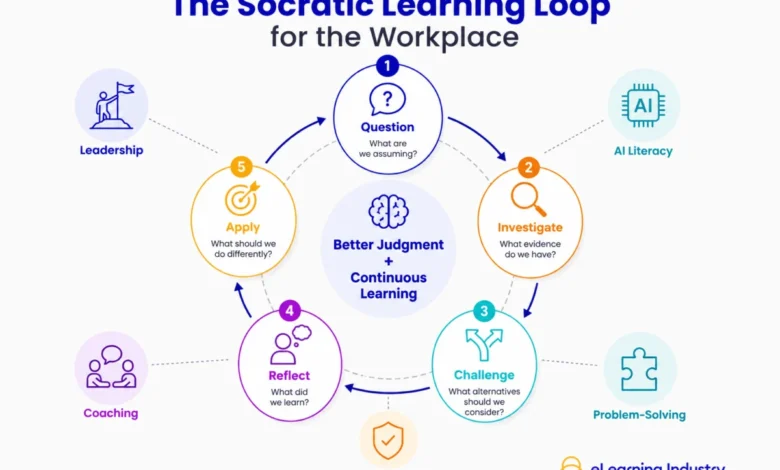
The Socratic Method operates through a structured, five-stage cycle designed to dismantle cognitive biases and promote objective analysis.
- Inquiry: The process begins with an open-ended question designed to elicit a specific position or thesis.
- Clarification: The facilitator asks the learner to define their terms and explain the foundation of their premise.
- Evidence Examination: The learner must provide empirical support or logical justification for their position.
- Assumption Challenge: The facilitator probes the underlying beliefs, testing for logical fallacies or gaps in the learner’s reasoning.
- Reflection: The final stage requires the learner to synthesize new insights, acknowledge previously held biases, and adjust their conclusions based on the dialogue.
This cyclical approach transforms the learner from a passive recipient of data into an active investigator of reality. In the context of modern workplace Learning and Development (L&D), this means replacing instructional slide decks with guided discovery.
Data-Driven Justification for Active Learning
Modern learning science provides robust empirical support for the Socratic approach. Research into "active learning" consistently demonstrates higher retention rates compared to passive lecture-based instruction. According to a seminal study published by the Proceedings of the National Academy of Sciences (PNAS), students in active learning classrooms outperformed those in traditional lecture settings by a significant margin. The study found that students in traditional lectures were 1.5 times more likely to fail than those in active learning environments.
Furthermore, the concept of "retrieval practice"—a core component of the Socratic Method—is supported by cognitive psychology. When learners are forced to generate their own answers through questioning rather than reviewing static content, neural pathways associated with long-term memory are significantly strengthened. By requiring learners to elaborate on their reasoning, the Socratic Method also promotes "metacognition," the awareness and understanding of one’s own thought processes, which is essential for complex decision-making in high-stakes corporate environments.

The Intersection of AI and Socratic Pedagogy
The rise of generative AI has fundamentally altered the value proposition of human education. With Large Language Models (LLMs) capable of synthesizing and summarizing vast amounts of information in seconds, the ability to memorize facts has been effectively devalued. Consequently, the premium on human capital has shifted toward "higher-order" cognitive skills: critical analysis, ethical judgment, and the ability to ask the right questions.
In many corporate sectors, organizations are integrating Socratic-based AI tutors. Unlike standard chatbots that provide immediate answers, these "Socratic AI" systems are programmed to delay gratification. They respond to user queries with follow-up questions, guiding the employee toward the answer rather than providing it. This forces the user to engage with the material, thereby mitigating the "hallucination" risks associated with blind reliance on AI outputs. By treating AI as a tool for inquiry rather than an oracle of truth, companies are fostering a workforce that is more skeptical, analytical, and prepared to handle the uncertainties of the modern market.
Applications in Corporate Leadership and Compliance
The practical application of the Socratic Method in L&D is multifaceted, extending into several critical business functions:
- Leadership Development: Instead of teaching managers "how" to lead via prescriptive rules, facilitators use scenarios where leaders must navigate conflicting priorities. By asking "What are the long-term implications of this trade-off?" the facilitator helps the leader internalize the rationale behind effective decision-making.
- Sales Enablement: The method is highly effective in training sales professionals to handle objections. By training reps to ask "What specifically about this pricing model gives you pause?" instead of immediately offering a discount, the salesperson can uncover the root cause of the prospect’s concern.
- Compliance and Ethics: Compliance training is often viewed as a "tick-the-box" exercise. Using the Socratic Method, trainers present ambiguous ethical dilemmas where there is no clear legal answer, forcing employees to map the situation against company values and personal integrity.
- Critical Thinking under Pressure: In sectors like cybersecurity or emergency response, the Socratic approach trains teams to identify their own assumptions during a crisis. By asking "What evidence do we have that this is a system failure rather than a user error?" teams can prevent catastrophic diagnostic mistakes.
Challenges to Implementation
Despite its clear benefits, the Socratic Method is not without its detractors and implementation hurdles. Critics argue that the method can be time-consuming and inefficient in environments where rapid, standardized training is required for regulatory compliance. Furthermore, the effectiveness of the method is highly dependent on the skill of the facilitator. A poorly executed Socratic dialogue can devolve into "interrogation," where learners feel belittled or confused, leading to disengagement rather than empowerment.
To overcome these challenges, L&D departments are increasingly moving toward a "hybrid" model. This involves providing foundational information through digital modules while reserving "synchronous" time—either in person or through virtual breakout rooms—for Socratic discussions. By front-loading the facts, facilitators can spend the limited live time focusing exclusively on the application and analysis of those facts, ensuring the dialogue remains productive and focused.
Future Implications for Organizational Culture
The long-term impact of adopting a Socratic organizational culture is a shift toward intellectual transparency. When leaders model the behavior of asking questions rather than asserting dominance, it creates a "psychological safety" net. Employees feel encouraged to challenge status-quo thinking, leading to increased innovation and the early identification of operational risks.
As the global economy continues to prioritize agility over stability, the ability to "think on one’s feet"—a hallmark of the Socratic tradition—will become the most critical differentiator for high-performing organizations. The transition from a culture of compliance to a culture of inquiry is not merely an educational upgrade; it is a strategic necessity for any company looking to navigate the complexities of an AI-driven, data-saturated future. By reclaiming the ancient wisdom of Socrates, modern enterprises are equipping their teams with the most durable tool in human history: the disciplined, relentless, and analytical mind.
Related posts: