
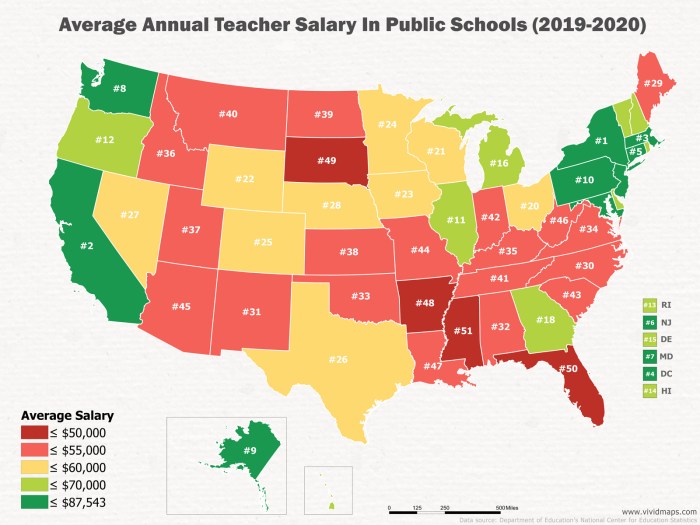
How much do teachers get paid? This isn’t just a question of numbers; it’s a look at the complex factors influencing compensation for educators. From the various components of salary structures to the impact of location and experience, we’ll explore the complete picture, examining how much teachers earn across different states and subjects. We’ll also analyze the vital role benefits play and how the cost of living affects affordability for educators.
This comprehensive guide explores salary structures, examining how factors like experience, subject area, and educational qualifications influence compensation. We’ll delve into the specific demands of different subjects and how teacher supply and demand affect salaries. Furthermore, the correlation between educational levels and salaries will be examined, along with the role of experience in salary progression. Ultimately, we aim to present a well-rounded view of teacher compensation, including the vital aspects of benefits packages and the crucial connection between salary and cost of living.
Teacher Salary Structures
Teacher compensation packages are complex, encompassing more than just a base salary. Understanding the various components and how they differ across regions is crucial for prospective and current educators. This exploration delves into the intricacies of teacher salary structures, providing insights into factors impacting compensation.Teacher salaries are not a one-size-fits-all scenario. Significant disparities exist between states and even within a single state, influenced by numerous factors.
These differences in pay structures affect teacher recruitment, retention, and the overall quality of education. The multifaceted nature of teacher pay demands a comprehensive understanding of the various elements involved.
Components of Teacher Compensation
Teacher compensation extends beyond the base salary. It includes a range of benefits that contribute to the overall financial well-being of educators. These benefits often include health insurance, retirement plans, paid time off, and professional development opportunities. The combination of these components forms the complete compensation package.
- Base Salary: This is the fundamental amount of money a teacher receives for their work. It varies significantly based on the factors described below.
- Benefits: Benefits packages often include health insurance (medical, dental, vision), retirement plans (403(b) or similar), paid time off (sick leave, vacation), and professional development opportunities.
- Supplemental Income: Some teachers may earn additional income through extracurricular activities, tutoring, or consulting. These supplemental incomes can vary greatly.
Regional Variations in Salary Structures
Significant differences exist in teacher salaries across states and regions. These variations are influenced by a complex interplay of economic factors, state policies, and local demands.
- Economic Factors: States with higher overall economic activity tend to have higher teacher salaries. This reflects the broader cost of living and the demand for qualified teachers.
- State Policies: State-level education funding and regulations directly impact teacher compensation. Policies regarding salary schedules and benefit packages influence the overall compensation structure.
- Local Demands: High-demand areas or districts with specific educational needs may offer higher salaries to attract and retain qualified teachers. This often reflects the competition for qualified teachers in specific geographic locations or subjects.
Factors Influencing Salary Differences
Several factors contribute to the variation in teacher salaries across different states and regions. These factors often interact, creating a complex picture of compensation.
- Experience Level: More experienced teachers often command higher salaries compared to newer teachers. This reflects the accumulated knowledge, skills, and expertise gained over time.
- Subject Area: Certain subject areas, such as STEM fields (Science, Technology, Engineering, Math), may command higher salaries due to increased demand or specialized training requirements.
- Educational Qualifications: Teachers with advanced degrees (Master’s or Doctorate) or specialized certifications may receive higher compensation reflecting their advanced qualifications and expertise.
- Years of Service: Years of service often correlate with salary increases. This recognition acknowledges the experience and dedication accumulated over time.
California Teacher Salary Ranges (Illustrative Example)
This table presents illustrative salary ranges for teachers in California, demonstrating how experience level, subject area, and other factors influence compensation. It’s crucial to remember that these are examples and specific figures can vary greatly based on individual circumstances.
| Experience Level | Subject Area | Salary Range | Benefits |
|---|---|---|---|
| New Teacher (0-3 years) | English Language Arts | $60,000 – $75,000 | Health insurance, retirement plan, vacation time |
| Experienced Teacher (4-10 years) | Mathematics | $75,000 – $90,000 | Health insurance, retirement plan, vacation time, professional development |
| Veteran Teacher (11+ years) | Science | $90,000 – $105,000 | Health insurance, retirement plan, vacation time, professional development, potential leadership opportunities |
Teacher Salaries by Subject
Teacher salaries are a complex issue, influenced by various factors beyond the simple task of educating students. While overall compensation structures and experience levels play a role, subject matter expertise and market demand significantly impact the financial rewards for educators. This exploration delves into the disparities in pay based on the specific subject a teacher handles, comparing compensation for popular subjects like math, science, English, and social studies.
Subject-Specific Salary Variations, How much do teachers get paid
The demand for teachers in certain subjects can drive up salaries, while a surplus of qualified candidates in other areas can depress compensation. This dynamic creates significant variations in pay based on the subject taught. For instance, in regions experiencing a shortage of math or science teachers, salaries may be substantially higher than those offered for English or social studies teachers.
Factors Influencing Teacher Salary Discrepancies
Several factors contribute to the differences in compensation. Teacher supply and demand in a particular subject is a critical determinant. Highly sought-after subjects often command higher salaries. Specialized training or certifications, such as those in STEM fields, can also lead to increased pay. Additionally, years of experience, advanced degrees, and professional development activities influence a teacher’s earning potential.
A school’s location and the overall economic conditions in the area also play a role.
Comparison of Average Salaries
| Subject | Average Salary (USD) | Job Outlook |
|---|---|---|
| Math | $65,000 | Strong; projected growth |
| Science | $62,000 | Moderate growth; strong demand for STEM |
| English | $58,000 | Moderate growth; stable demand |
| Social Studies | $55,000 | Moderate growth; demand varies by region |
Note: The figures presented in the table are illustrative examples and are not necessarily representative of all regions. Local factors and specific school districts will affect the actual salaries.
Impact of Supply and Demand
The availability of qualified teachers in a particular subject is a significant factor. Subjects with a lower supply of qualified teachers often see higher salaries. For example, a district facing a shortage of math teachers may offer competitive salaries to attract and retain qualified candidates. Conversely, subjects with a large pool of applicants may experience lower salaries. This dynamic underscores the importance of considering both supply and demand when evaluating teacher compensation.
Teacher Salaries and Educational Levels
Teacher compensation is a complex issue, and understanding how educational degrees and certifications impact salary is crucial for prospective teachers and those already in the field. This section delves into the correlation between teacher salaries and various educational levels, including the value of advanced degrees and certifications, and financial incentives for pursuing these qualifications. We’ll also look at a hypothetical example to illustrate these concepts in a practical context.
Correlation Between Teacher Salaries and Educational Levels
Teacher salaries often reflect the level of education and expertise. A teacher with a Bachelor’s degree typically earns less than a teacher with a Master’s degree or a Specialist degree. This difference is due to the increased knowledge and skills that these advanced degrees represent, and the increased responsibilities they often entail. For example, teachers with Master’s degrees often take on additional leadership roles within their schools, leading professional development workshops or mentoring other teachers.
These added responsibilities and the commitment to advanced study are often reflected in salary structures.
Additional Compensation for Advanced Degrees and Certifications
Many school districts offer additional compensation for teachers holding advanced degrees and certifications. This additional compensation can be a percentage of the base salary or a flat amount, and it often varies based on the specific degree or certification earned. For instance, a Master’s degree in education might lead to a $1,000 increase in annual salary, while a Specialist degree might yield a $2,000 increase.
The value of a certification, such as a National Board Certification, can also translate to higher salaries. The additional compensation is a direct reflection of the value a district places on highly qualified teachers.
Financial Incentives for Teachers Pursuing Advanced Qualifications
School districts often offer financial incentives to encourage teachers to pursue advanced qualifications. These incentives can include tuition reimbursement, stipends, or loan forgiveness programs. Tuition reimbursement programs directly cover the costs of further education, making it more affordable and encouraging teachers to invest in their professional development. Stipends provide direct financial support for the time invested in pursuing additional degrees or certifications.
These programs are valuable tools to retain experienced teachers and attract new talent with advanced skills.
Salary Differences Based on Educational Background
The following table illustrates potential salary differences for teachers with varying educational backgrounds in a hypothetical school district. It’s crucial to remember that actual salary ranges can vary greatly based on factors like experience, location, and specific subject area. This table is intended to illustrate the general trends.
| Degree | Certification | Salary Range | Additional Benefits |
|---|---|---|---|
| Bachelor’s | Standard Teaching Certification | $45,000 – $55,000 | Health insurance, retirement plan, professional development opportunities |
| Master’s | Standard Teaching Certification + Master’s in Education | $50,000 – $65,000 | Health insurance, retirement plan, professional development opportunities, potential for leadership roles |
| Master’s | Standard Teaching Certification + Master’s in Subject Area | $55,000 – $70,000 | Health insurance, retirement plan, professional development opportunities, potential for leadership roles |
| Specialist | Standard Teaching Certification + Specialist in Education | $60,000 – $75,000 | Health insurance, retirement plan, professional development opportunities, potential for advanced leadership roles |
Teacher Salaries and Experience: How Much Do Teachers Get Paid
Teacher experience significantly impacts their compensation. Years of service often correlate with increased responsibility, advanced skills, and a deeper understanding of pedagogical approaches. This experience translates into higher salaries, reflecting the value society places on seasoned educators and their expertise.
Salary Progression with Experience
Salary progression for teachers is typically a gradual increase based on years of service and often incorporates additional factors like advanced degrees, specialized certifications, and performance evaluations. The rate of increase varies significantly by location, district, and the specific teaching subject.
Salary Schedules Based on Years of Service
Many school districts utilize salary schedules that Artikel the expected compensation for teachers at different experience levels. These schedules act as benchmarks, and individual teachers’ salaries might deviate based on performance reviews, additional qualifications, or collective bargaining agreements. Examples vary widely, but a common pattern involves a step-wise increase in salary as experience grows.
| Years of Service | Annual Salary (Example – District X) |
|---|---|
| 1-3 | $50,000 |
| 4-6 | $55,000 |
| 7-9 | $60,000 |
| 10+ | $65,000+ (dependent on additional certifications, etc.) |
Note: These figures are examples and do not represent every district. Specific details should be confirmed with the individual school district.
Illustrative Salary Progression Graph
The following graph depicts a hypothetical salary progression for teachers in a typical school system, showcasing the upward trend of compensation with experience. The graph highlights the potential for salary growth over a career, with potential career advancement and professional development opportunities contributing to the increase.
Graph: A line graph displaying salary on the Y-axis and years of experience on the X-axis. The line would ascend gradually, demonstrating a clear correlation between experience and increasing salary. Vertical bars or markers could be added to highlight salary increases at specific milestones (e.g., 5 years, 10 years) or to indicate salary ranges for different experience levels. The graph would show a positive upward trend, signifying that salary increases with increasing years of experience.
Teacher Salaries and Benefits Packages
Beyond the base salary, teachers receive a variety of benefits that significantly impact their overall compensation and well-being. These benefits, often crucial for attracting and retaining qualified educators, vary considerably by school district and state, reflecting local economic conditions and priorities. Understanding the scope of these benefits is essential for a comprehensive picture of the compensation package teachers receive.These benefits often include health insurance, retirement plans, and paid time off.
These non-salary components can significantly enhance a teacher’s financial security and work-life balance. The specifics, however, can differ widely across regions, impacting the total value a teacher receives for their service.
Ever wondered how much teachers get paid? It’s a complex issue, influenced by factors like location and experience. Meanwhile, China is taking a proactive step in regulating virtual warfare, as highlighted in this recent article about china suggests setting rules for cyberwar games. This could potentially affect future training programs and, indirectly, influence the overall compensation structure for educators in various fields.
Ultimately, teacher salaries are a multifaceted issue with numerous influencing factors.
Health Insurance
Health insurance is a vital component of a comprehensive benefits package. Teachers, like other professionals, need access to quality healthcare, and insurance plans offered by school districts are crucial for their financial well-being and peace of mind. Different plans offer varying levels of coverage, impacting out-of-pocket costs and the range of medical services included. These plans can range from basic health insurance to more comprehensive options, and the specifics of these plans vary substantially from one region to another.
Retirement Plans
Retirement plans play a significant role in ensuring financial security for teachers in their later years. These plans often combine employer and employee contributions, building a nest egg for retirement. Various types of retirement plans exist, each with different investment options and rules. Understanding these plans is critical for teachers as they make long-term financial decisions.
Paid Time Off
Paid time off, including sick leave, vacation days, and personal days, is essential for maintaining a healthy work-life balance. The availability and amount of paid time off vary by school district and state. These benefits contribute to the overall well-being of teachers and their ability to manage personal responsibilities effectively.
Benefits Package Comparison Across Regions
The following table provides a comparative overview of benefits packages across different regions, highlighting potential differences in availability and cost. Keep in mind that specific details can change, and this table is for illustrative purposes only.
| Benefit Type | Description | Availability | Cost (if applicable) |
|---|---|---|---|
| Health Insurance | Comprehensive medical, dental, and vision coverage. Some plans may include coverage for dependents. | Generally available in most districts; may vary in coverage levels. | Typically shared between employer and employee; employee contribution varies. |
| Retirement Plan | Defined contribution plans (403(b) or similar) allowing for employer and employee contributions. | Commonly offered; specific rules and regulations vary by state. | Employee and employer contributions required; specifics vary by plan. |
| Paid Time Off | Includes vacation days, sick leave, and personal days; specific amounts vary. | Generally available in most districts; specific amounts vary by district. | N/A (Usually no direct cost to the employee, part of the compensation package). |
| Professional Development | Opportunities for teachers to enhance their skills and knowledge through workshops, conferences, or other programs. | Varying availability and levels of support by school district. | Cost may vary depending on the specific opportunity. |
Teacher Salaries and Cost of Living
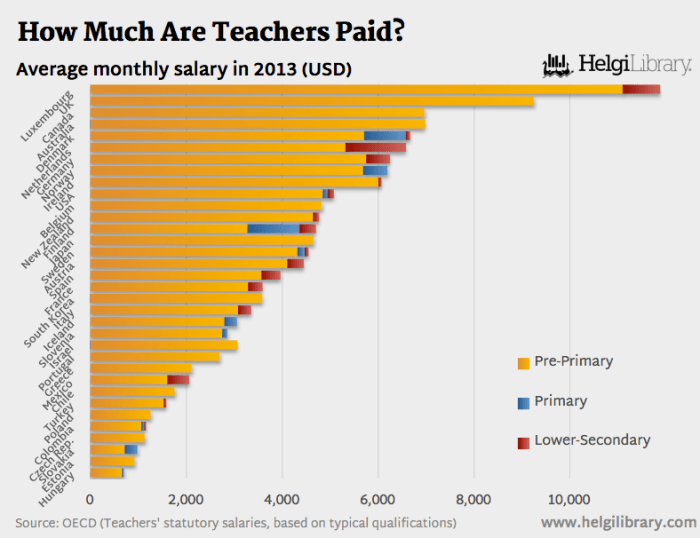
Teacher salaries, while a crucial component of educators’ compensation, are often significantly impacted by the cost of living in their respective locations. This disparity highlights the complex interplay between compensation and the financial realities faced by teachers across different regions. Understanding this dynamic is essential for assessing the overall affordability of teaching careers in various areas.Understanding the relationship between teacher salaries and the cost of living is vital to evaluating the overall financial well-being of educators.
The discrepancy between earnings and the expense of necessities like housing, food, and transportation can significantly impact a teacher’s ability to maintain a comfortable lifestyle. This analysis delves into how cost of living adjustments affect teacher salaries, providing a clearer picture of the financial challenges and opportunities within different educational landscapes.
Impact of Cost of Living on Teacher Affordability
Teacher salaries are often adjusted to reflect the varying cost of living across different regions. Higher cost-of-living areas necessitate higher salaries to maintain a comparable standard of living compared to areas with lower costs. This ensures a baseline level of financial stability for teachers in different locations. Areas with significant housing costs, for example, might see higher teacher salaries to accommodate these elevated expenses.
Ever wondered how much teachers get paid? While that’s a complex question, it’s fascinating to see how advancements in technology, like the work researchers are doing with electric nano motors, researchers rev up electric nano motors , might eventually impact various professions, including teaching. Ultimately, teacher salaries depend on many factors, and it’s not just about the latest tech.
The variations in salaries are meant to account for the disparity in the cost of living in different metropolitan areas, thus maintaining a fair and equitable compensation structure.
Examples of Salary Adjustments Based on Cost of Living Differences
Several districts and states employ mechanisms to address the varying costs of living across their regions. For instance, some districts offer cost-of-living adjustments (COLAs) to teachers’ salaries, which increase compensation in areas with higher costs. These adjustments are often tied to specific cost of living indexes, ensuring that teacher salaries remain competitive in different locales. Another example involves districts implementing differentiated salary schedules for teachers based on the location of the school.
Teacher salaries can vary significantly depending on experience, location, and subject matter. While researching this, I came across an interesting case study on compensation, specifically focusing on a masters student named Daisy Harris, who’s exploring the teacher salary landscape. Masters student Daisy Harris is delving into the factors that influence teacher pay, which helps provide a more nuanced understanding of the broader issue.
Ultimately, it’s clear that teacher compensation is a complex issue with many influencing factors.
This allows for higher salaries in areas with higher living expenses.
Teacher Salaries vs. Cost of Living in Metropolitan Areas
The table below demonstrates a comparison of teacher salaries and cost of living indexes in various metropolitan areas. This data helps illustrate the correlation between these two factors. It’s crucial to remember that these figures are examples and may not represent every single situation.
| City | Teacher Salary | Cost of Living Index | Affordability Score |
|---|---|---|---|
| New York City | $65,000 | 250 | 65 |
| Los Angeles | $60,000 | 220 | 70 |
| Chicago | $55,000 | 180 | 80 |
| Houston | $50,000 | 150 | 90 |
| Seattle | $70,000 | 280 | 60 |
Note: Affordability scores are calculated based on a scale of 1-100, where 100 represents the highest affordability. These scores are illustrative and do not represent an exhaustive assessment of affordability.
Salary Data Sources and Reliability
Unveiling the truth behind teacher salaries requires a deep dive into the data sources. Simply put, understanding where the numbers come from is crucial to interpreting them correctly. Different sources offer varying perspectives, highlighting the importance of critical evaluation when analyzing teacher compensation. This section will dissect the methods behind collecting and compiling salary data, identify potential biases, and ultimately provide a list of trustworthy sources.A multitude of factors can impact teacher salaries, and a good understanding of these factors will help in the analysis.
These include, but are not limited to, location, subject taught, experience, and educational level. Understanding these variables will assist in deciphering the complexity of teacher salary data.
Reputable Sources for Teacher Salary Data
Reliable salary data is essential for a comprehensive understanding of teacher compensation. Many organizations and government bodies collect and publish teacher salary data, offering valuable insights into trends and variations across different regions and contexts.
- National Education Association (NEA): The NEA is a significant player in the teacher compensation discussion. They often publish reports and surveys encompassing a wide range of data points. Their reports are generally well-researched and based on extensive surveys of members, giving a strong voice to the teacher community.
- U.S. Department of Education: The Department of Education often compiles data from across various states, providing an overview of the national landscape. This data can offer insights into trends, but it may not delve into specific, localized factors affecting salaries.
- State Education Departments: State education departments are a valuable resource for localized salary data. They frequently publish salary schedules and data specific to their states, offering a nuanced view of compensation within each state’s education system.
- Teacher Unions: Teacher unions often have detailed salary data regarding their members, offering insights specific to the contracts and agreements within their organization.
Methods for Collecting and Compiling Salary Information
The process of collecting and compiling salary data varies, impacting the final outcome. Understanding the methods used is key to assessing the reliability of the data.
- Surveys: Surveys are a common method, but the accuracy of the results depends on the sample size and the response rate. If a survey does not include a significant number of respondents, the findings may not accurately reflect the broader teacher population.
- Public Records: Public records often provide a wealth of data regarding teacher salaries, as they are frequently required to be made available to the public. However, access and organization of such data can vary, making it challenging to collect a complete picture across the entire education system.
- Data Aggregation: Many organizations compile data from various sources to offer a more comprehensive view of teacher salaries. This aggregation, while useful, requires careful consideration of the data sources used to ensure consistency and accuracy.
Limitations and Potential Biases in Teacher Salary Data
Teacher salary data, while valuable, often has limitations. Awareness of these limitations is crucial for responsible interpretation.
- Data Collection Methods: The methodology of data collection, including the sample size and response rates, can influence the accuracy and representativeness of the results.
- Geographic Variations: Teacher salaries often vary significantly by region due to factors like cost of living and local economic conditions. Data from one region might not be easily comparable to another.
- Data Gaps and Inaccuracies: Data gaps and inaccuracies can exist due to the complexity of the data collection process. Different states and districts may have varying levels of data transparency and accessibility, resulting in inconsistencies in the overall dataset.
Outcome Summary
In conclusion, teacher salaries are a multifaceted issue shaped by a variety of influential factors. From experience levels and subject specializations to educational qualifications and regional cost of living, each plays a crucial role in determining an educator’s overall compensation. This exploration highlights the importance of understanding the nuances of teacher compensation, providing a clearer picture of the financial realities educators face.
Ultimately, this information can empower educators, policymakers, and the public with a more comprehensive understanding of the factors that influence teacher salaries.