
7 time management tips for students sets the stage for this enthralling narrative, offering readers a glimpse into a world where effective time management isn’t just a skill, but a superpower for success in academics and beyond. We’ll explore the crucial role of time management in student life, examining how to conquer common challenges and unlock your potential for productivity.
From understanding the fundamental principles of time blocking and prioritization to utilizing technology and overcoming procrastination, this guide will equip you with actionable strategies. We’ll delve into practical techniques for managing your time effectively, helping you navigate the complexities of student life with ease and confidence.
Introduction to Effective Time Management for Students
Effective time management is crucial for student success, impacting academic performance, personal well-being, and future prospects. Students face a multitude of demands, from coursework and exams to extracurricular activities and social commitments. Developing effective time management skills empowers students to navigate these demands successfully, reducing stress and maximizing their potential.Strong time management strategies allow students to prioritize tasks, allocate sufficient time for each, and ultimately achieve their academic goals more efficiently.
This translates to better grades, reduced procrastination, and improved mental health. By understanding and applying these strategies, students can create a more balanced and fulfilling student experience, setting themselves up for long-term academic and personal success.
Importance of Time Management for Student Success
Time management skills are not merely helpful; they are essential for academic achievement. Students who effectively manage their time often experience improved grades, reduced stress, and increased confidence. Procrastination, a common pitfall, can lead to rushed work, lower quality output, and heightened anxiety. Conversely, effective time management fosters a sense of control, allowing students to approach tasks with a more strategic and composed mindset.
Key Benefits of Effective Time Management Strategies
Effective time management equips students with a range of advantages. Students who master time management skills experience reduced stress levels and improved mental well-being. The ability to efficiently allocate time leads to more focused study sessions, enhanced learning, and improved academic performance. Moreover, effective time management fosters a sense of accomplishment and autonomy, contributing to increased self-esteem and personal growth.
So, I’ve been thinking about those 7 time management tips for students lately, and it got me pondering. A journalist, facing a sudden career shift, recently learned the valuable digital skills needed to navigate the changing media landscape, like in this insightful piece on journalist in crisis learns the digital ropes. It’s a fascinating parallel; adapting to new tools and systems, just like efficiently managing your study schedule, requires a proactive and adaptable approach.
These 7 time management tips for students can be crucial for success in any field.
Historical Context of Time Management Principles
The principles of time management have evolved throughout history, with notable figures like Benjamin Franklin advocating for meticulous scheduling and task prioritization. These early approaches, though rudimentary by today’s standards, laid the groundwork for modern time management techniques. Ancient civilizations, like the Egyptians and Romans, recognized the value of planning and organizing tasks to maximize productivity. The concept of managing time efficiently has a long and rich history, reflecting a persistent human need to optimize our use of limited resources.
Common Time Management Challenges Faced by Students
Students face numerous hurdles when attempting to implement effective time management strategies. These include competing demands like extracurricular activities, social commitments, and part-time jobs. Procrastination, a common student pitfall, can derail the best-laid plans. Lack of adequate planning and organization often leads to missed deadlines and a feeling of being overwhelmed. A lack of clear priorities and insufficient self-discipline can further complicate the process of effective time management.
Comparison of Time Management Approaches
| Approach | Description | Strengths | Weaknesses ||—|—|—|—|| The Pomodoro Technique | Focus on short, intense work periods (e.g., 25 minutes) followed by short breaks. | Increases focus, reduces burnout, improves concentration. | Can be challenging to maintain consistency, may not be suitable for all tasks. || Eisenhower Matrix | Prioritizes tasks based on urgency and importance. | Helps students focus on high-priority tasks, minimizes wasted time.
| Requires careful assessment of tasks, may lead to overlooking less urgent but important items. || Time Blocking | Allocates specific time slots for different tasks. | Creates structure, enhances productivity, provides a clear visual representation of schedule. | Can be rigid and inflexible, may not account for unexpected events. || The Two-Minute Rule | Tasks taking less than two minutes should be completed immediately.
| Prevents small tasks from piling up, improves efficiency. | Can be easily abused, may not apply to all tasks. |
Understanding Time Management Principles
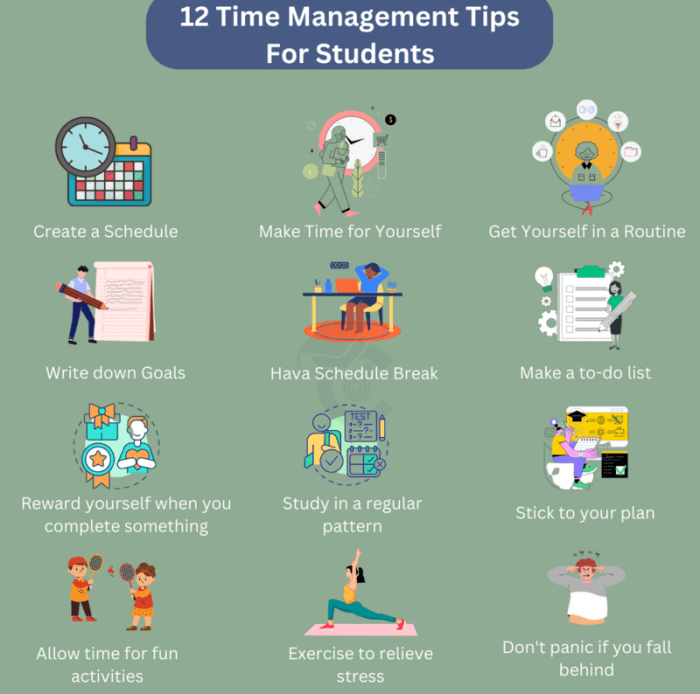
Effective time management isn’t just about working harder; it’s about working smarter. It’s a crucial skill for students, allowing them to balance academics, extracurricular activities, social life, and personal well-being. Understanding key principles like time blocking, prioritization, realistic goals, and time estimation is fundamental to maximizing productivity and minimizing stress.By mastering these principles, students can transform their approach to tasks, fostering a sense of control and accomplishment in their academic journey.
Time management isn’t a one-size-fits-all solution; it’s a personalized strategy that adapts to individual needs and preferences.
Time Blocking
Time blocking is a scheduling technique where specific time slots are dedicated to particular tasks. This structured approach helps students visualize their day and allocate appropriate time for different activities. For example, a student might block out 2 hours for studying math on Monday evening, ensuring dedicated time for this subject. This prevents tasks from bleeding into each other, leading to more focused work and improved productivity.
Prioritization Techniques
Prioritization is essential for managing the overwhelming demands of student life. Students need a systematic method for distinguishing urgent from important tasks. A common technique is the Eisenhower Matrix, which categorizes tasks based on urgency and importance. This matrix helps students allocate time effectively to high-priority tasks, minimizing wasted effort on less crucial activities.
Realistic Goals and Expectations
Setting realistic goals is vital for student success. Unrealistic expectations can lead to frustration and burnout. Students should break down large tasks into smaller, manageable steps. For example, instead of aiming to finish a lengthy research paper in one day, students should schedule smaller, focused sessions for reading, note-taking, outlining, and writing. This incremental approach fosters a sense of accomplishment and reduces the pressure of overwhelming deadlines.
Time Estimation
Accurate time estimation is crucial for planning. Students should develop a realistic understanding of how long tasks typically take. This involves considering factors like the complexity of the task, the student’s skill level, and any potential interruptions. For instance, if a student usually takes 30 minutes to complete a chapter summary, they should allocate this amount of time for similar tasks in the future.
Seven time management tips for students can be incredibly helpful, but sometimes a broader perspective is needed. Thinking big but starting small, as discussed in the Cranfield University podcast transcript on startup processes , is a powerful concept that can be applied to any task, especially studying. Ultimately, these tips, when combined with the mindset of starting small and gradually building momentum, can really help you succeed in your studies.
Identifying and Eliminating Time Wasters
Time wasters are activities that consume time without contributing to productivity. Students need to identify these activities and develop strategies to eliminate or minimize them. This includes recognizing and minimizing distractions like social media, excessive video games, or lengthy phone calls. A simple technique is to set aside specific times for these activities, rather than allowing them to interrupt study sessions.
Keeping a detailed log of how time is spent can help pinpoint these time-consuming activities.
Practical Time Management Techniques
Mastering time management isn’t about squeezing more into your day; it’s about prioritizing effectively and organizing your tasks to achieve your goals efficiently. This involves understanding your personal productivity patterns and adapting strategies to optimize your time allocation. Effective time management is a cornerstone of academic success, allowing you to balance studies with extracurricular activities and personal well-being.Effective time management is not a one-size-fits-all solution; it’s a personalized process of learning how to structure your schedule to optimize your performance and well-being.
Recognizing your peak productivity times, whether early morning or late evening, and scheduling your most demanding tasks accordingly, is key to maximizing your output.
7 Time Management Tips for Students
Effective time management for students involves strategic planning and consistent execution. These practical tips empower students to manage their time efficiently and effectively, fostering a healthy balance between academic responsibilities and personal well-being.
- Prioritize Tasks: Identifying tasks based on urgency and importance is crucial. Use the Eisenhower Matrix (urgent/important) to categorize tasks. High-priority, urgent tasks should be tackled immediately, while important, non-urgent tasks should be scheduled for dedicated time blocks. This ensures that critical assignments and deadlines are addressed effectively.
- Create a Weekly Schedule: A weekly schedule is an essential tool for visualizing and managing your time. It should incorporate both academic commitments (lectures, study sessions, exam preparation) and personal responsibilities (social events, exercise, leisure). This visual representation helps you stay organized and prevents feeling overwhelmed by a multitude of tasks.
- Break Down Large Tasks: Large assignments or projects can seem daunting. Breaking them into smaller, more manageable sub-tasks makes the overall workload less intimidating. This approach allows you to focus on one step at a time, increasing motivation and reducing procrastination.
- Time Blocking: Allocate specific time slots for specific tasks. For instance, dedicate a block of time for studying a particular subject or working on a specific assignment. This structured approach helps you maintain focus and track your progress.
- Learn to Say No: It’s essential to recognize your limitations and avoid overcommitting yourself. Saying no to requests or activities that don’t align with your priorities or available time is a crucial skill for effective time management. This ensures that you don’t spread yourself too thin, which can lead to stress and poor performance.
- Utilize Technology for Organization: There are numerous apps and software designed to help manage tasks, deadlines, and schedules. Explore options such as calendar apps, task management tools, or note-taking apps. Choosing the right tool can significantly enhance your organizational skills.
- Regular Review and Adjustment: Your weekly schedule isn’t static. Regularly review and adjust your schedule based on your progress, challenges, and changing priorities. This ensures that your time management strategy remains flexible and adaptable to your evolving needs.
Creating a Weekly Schedule
A well-structured weekly schedule is the cornerstone of effective time management. It provides a clear roadmap for the week, allowing you to allocate time for various tasks and responsibilities. The schedule should be tailored to your individual needs and preferences, incorporating your peak productivity times.A sample weekly schedule could include blocks of time for attending classes, studying specific subjects, working on assignments, engaging in extracurricular activities, and allocating time for personal well-being.
A template can be created to track your schedule.
Managing Multiple Assignments and Deadlines
Managing multiple assignments and deadlines requires a systematic approach. Prioritize tasks based on urgency and importance, using a method like the Eisenhower Matrix. Break down large assignments into smaller, more manageable tasks. Establish clear deadlines for each sub-task and allocate specific time blocks for each assignment.
Helpful Resources for Students
- University Academic Advising Services: University advising services offer personalized guidance on time management strategies.
- Online Time Management Courses: Online resources provide various courses on effective time management techniques.
- Student Support Groups: Connecting with other students facing similar challenges can provide valuable insights and support.
Breaking Down Large Tasks
Breaking down large tasks into smaller, more manageable sub-tasks is a key time management strategy. This approach reduces the feeling of being overwhelmed by the magnitude of the task and allows for a more focused approach. For example, if you have a research paper due, break it down into sub-tasks like selecting a topic, outlining the paper, conducting research, writing each section, and editing.
Utilizing Technology for Time Management
Harnessing the power of technology can significantly improve your time management skills as a student. From scheduling classes and appointments to tracking progress and managing distractions, digital tools can streamline your workflow and help you stay organized. By effectively utilizing these tools, you can reclaim valuable time and dedicate it to academic pursuits, extracurricular activities, and personal well-being.Technology empowers students to be more efficient in managing their time, tasks, and overall academic life.
It allows for greater flexibility, improved organization, and enhanced productivity. By integrating technology into your time management strategy, you can significantly reduce stress and improve your overall academic experience.
Time Management Apps and Software
Various applications and software are designed to aid students in managing their time effectively. Choosing the right tool depends on individual preferences and specific needs. A well-chosen application can streamline tasks, track progress, and help students stay organized.
| App/Software | Key Features |
|---|---|
| Google Calendar | Provides a centralized platform for scheduling classes, appointments, and deadlines. Offers integration with other Google services. |
| Trello | A visual project management tool for organizing tasks and projects. Facilitates collaboration and task delegation. |
| Asana | A comprehensive project management platform for managing complex tasks and projects. Allows for task prioritization and assigning responsibilities. |
| Todoist | A to-do list app that allows for task organization, scheduling, and prioritization. Provides customizable features and integrates with other apps. |
| Toggl Track | A time-tracking tool that helps users monitor their work hours and analyze their productivity patterns. |
Effective Digital Calendar Usage
Digital calendars are invaluable for students. They provide a centralized location to schedule appointments, deadlines, and important events, minimizing the risk of missed commitments. Proper utilization of these calendars is crucial for efficient time management.A well-maintained digital calendar is a cornerstone of effective time management. It should be used to schedule not just classes and meetings, but also study sessions, extracurricular activities, and personal appointments.
This proactive approach ensures you’re aware of your commitments and can effectively allocate your time. For instance, scheduling study blocks alongside other activities helps ensure focused study sessions.
Digital Reminders and Notifications
Digital reminders and notifications are crucial for timely task completion. They act as a proactive approach to preventing missed deadlines and fostering better time management. These tools can be customized to suit individual needs and preferences.
“Utilizing digital reminders effectively can significantly reduce the likelihood of missing important deadlines.”
Utilizing these tools effectively allows you to proactively address tasks and commitments. Setting reminders for upcoming assignments or appointments ensures you’re prepared and avoid last-minute stress.
Managing Email and Social Media Distractions, 7 time management tips for students
Email and social media can be significant time wasters. Implementing strategies to manage these distractions is crucial for effective time management. Establishing clear boundaries and designated times for checking these platforms is essential.Designate specific times for checking emails and social media. This helps to minimize the impact of these platforms on your productivity and focus. For instance, scheduling email checks during breaks or designated times will help you stay on track.
Tracking Progress and Analyzing Productivity
Tracking progress and analyzing productivity patterns is essential for optimizing time management. These analyses reveal insights into your work habits, helping you identify areas for improvement and optimize your approach. Using dedicated tools helps visualize and understand your patterns.Utilizing tools like Toggl Track allows you to track your work hours and analyze your productivity patterns. This detailed understanding allows for the identification of unproductive activities and can guide you in restructuring your time allocation for maximum efficiency.
For example, recognizing you spend too much time on social media during study sessions will allow you to make adjustments to improve focus.
Overcoming Time Management Challenges

Juggling classes, extracurriculars, part-time jobs, and social life can feel overwhelming for students. Effective time management isn’t just about scheduling; it’s about understanding and overcoming the obstacles that often derail our best-laid plans. This section explores common challenges and strategies for navigating them successfully.Time management is a skill that takes practice and adaptation. Students often face unique hurdles that can significantly impact their ability to stay organized and productive.
Thinking about those crucial 7 time management tips for students? They’re super important, especially when you consider the global challenges, like the high-stakes cyber struggle between civilizations, discussed in a fascinating Q&A with Gen Wesley Clark, ret. This insightful discussion reminds us that effective time management is key to navigating demanding academic landscapes, just as it’s essential in the complex world of international security.
So, back to those time management tips—let’s dive in!
By recognizing these challenges and implementing targeted solutions, students can reclaim control over their schedules and achieve their academic goals.
Common Time Management Challenges for Students
Students frequently encounter a variety of hurdles when attempting to manage their time effectively. These obstacles can stem from internal factors, such as procrastination, or external factors, such as conflicting commitments. Recognizing these common challenges is the first step toward developing effective coping mechanisms.
- Procrastination: The tendency to delay tasks until the last minute is a pervasive issue for students. This often stems from a fear of failure, a lack of motivation, or poor task prioritization.
- Distractions: In today’s digital age, students face constant distractions from social media, electronic devices, and other external stimuli. These distractions can significantly disrupt concentration and productivity.
- Lack of Prioritization: Students sometimes struggle to prioritize tasks effectively, leading to a feeling of being overwhelmed and unable to make progress.
- Poor Organization: Effective time management often relies on a well-structured approach to task organization and planning. Without this, students may struggle to keep track of deadlines and commitments.
- Insufficient Time: The demands of academic work, social commitments, and personal responsibilities can sometimes feel overwhelming, leaving students with insufficient time to complete tasks effectively.
Strategies for Managing Procrastination
Procrastination is a common enemy for students, often leading to stress and decreased performance. Developing strategies to combat this habit is crucial for maintaining a healthy work-life balance.
- Break Down Tasks: Large assignments can feel daunting. Breaking them down into smaller, more manageable steps can make them seem less overwhelming and increase motivation.
- Set Realistic Deadlines: Establishing achievable deadlines is key to preventing procrastination. Overly ambitious goals can lead to feelings of inadequacy and a tendency to delay.
- Identify Triggers: Understanding the specific situations or emotions that trigger procrastination can help students develop strategies to avoid these triggers.
- Reward Yourself: Acknowledge and reward yourself for completing tasks. This positive reinforcement can motivate you to stay on track.
Impact of Stress on Time Management and Coping Mechanisms
Stress can significantly impact a student’s ability to manage time effectively. Recognizing the effects of stress and implementing coping mechanisms is essential for academic success.
- Stress Reduction Techniques: Stress-reducing techniques such as deep breathing exercises, meditation, and mindfulness practices can help students manage stress more effectively. Regular exercise and adequate sleep are also crucial for reducing stress levels.
- Prioritize Self-Care: Students need to prioritize self-care activities, such as spending time in nature, engaging in hobbies, or simply relaxing. This helps maintain emotional well-being and reduces stress levels.
- Seek Support: Talking to friends, family, or a counselor about stress can provide valuable support and perspective.
Techniques for Improving Focus and Concentration
Maintaining focus and concentration is vital for effective time management. These techniques can help students enhance their ability to concentrate on tasks.
- Minimize Distractions: Identify and minimize potential distractions in your study environment. This may include turning off notifications on your phone or finding a quiet study space.
- Time Management Techniques: Implementing time management techniques like the Pomodoro Technique, where you work in focused bursts, can significantly improve concentration.
- Active Recall: Actively recalling information rather than passively rereading it can strengthen memory and improve focus.
Building a Supportive Study Environment
Creating a supportive study environment is crucial for optimal focus and productivity. This involves considering various aspects of the physical and mental space.
- Physical Space: Ensure your study area is well-lit, organized, and free from clutter. A comfortable and conducive environment can significantly impact focus and productivity.
- Mental Space: Create a mental space conducive to learning. This involves managing stress, setting clear goals, and avoiding negative self-talk.
Sustaining Effective Time Management Habits: 7 Time Management Tips For Students
Effective time management isn’t a one-time fix; it’s a continuous process of learning, adapting, and refining strategies. Success hinges on consistently implementing techniques and adjusting them based on feedback and changing circumstances. This ongoing process ensures long-term effectiveness and allows students to maximize their productivity and academic performance.Sustaining effective time management habits requires a proactive approach, encompassing self-evaluation, consistent practice, and a flexible mindset.
Students must recognize the importance of adaptation and refinement in their strategies, embracing the dynamic nature of academic life. This section delves into the crucial elements for long-term success in time management.
Self-Assessment and Strategy Adjustment
Regular self-assessment is essential for identifying strengths and weaknesses in time management. By critically evaluating how time is spent, students can pinpoint areas where they are wasting time or struggling to meet deadlines. This introspection helps in understanding individual learning styles and preferences, enabling more personalized strategies. Once areas of improvement are identified, students can adjust their strategies to better suit their needs and improve efficiency.
For example, if a student consistently finds themselves procrastinating on certain tasks, they might adjust their schedule to incorporate shorter, more frequent work sessions or implement a reward system for completing tasks.
Consistency in Implementing Techniques
Consistency is key to reaping the benefits of time management techniques. Regularly employing chosen methods, even when faced with distractions or unexpected events, fosters a habit of efficient time allocation. This consistency builds momentum and establishes a routine that becomes second nature, ultimately increasing productivity over time. Think of it like any skill; consistent practice is essential for mastery.
Tracking and Evaluating Time Management Strategies
Tracking time spent on various activities is a crucial step in evaluating the effectiveness of time management strategies. Using a planner, digital calendar, or even a simple notebook, students can monitor how they allocate their time. This allows for objective analysis of where time is being spent and whether it aligns with goals and priorities. For instance, a student might notice that they spend significantly more time on social media than initially anticipated.
This data can then inform adjustments to their schedule and help prioritize tasks.
The Role of Feedback in Refining Skills
Feedback plays a crucial role in refining time management skills. Seeking input from peers, professors, or mentors can provide valuable perspectives on time management approaches. Constructive criticism can pinpoint areas needing improvement and highlight successful strategies. By incorporating feedback, students can refine their strategies to better meet their academic needs. For instance, if a professor suggests that a student allocate more time for reviewing material, that feedback can directly inform adjustments to their study schedule.
Adapting to Different Academic Periods
Academic periods, such as exam weeks or project deadlines, often require adjustments to time management approaches. Students must recognize the fluctuating demands of different academic periods and adjust their strategies accordingly. For example, during exam periods, students might need to allocate more time for studying and less time for social activities. Flexibility is paramount to success in navigating these periods effectively.
This adaptation ensures that time management strategies remain relevant and effective throughout the academic year.
Real-World Examples and Case Studies
Effective time management isn’t just a theoretical concept; it’s a practical skill that translates into tangible results for students. This section dives into real-world examples to demonstrate how applying these techniques can lead to academic success and personal growth. We’ll explore case studies, examine the impact on performance, and highlight how time management spills over into other areas of life.Understanding how successful students approach time management is crucial.
It’s about identifying patterns, recognizing what works, and adapting strategies to fit individual needs and learning styles. The examples below show the diverse ways students leverage time management techniques to achieve their goals.
Case Studies of Successful Students
Time management is not a one-size-fits-all solution. Each student has unique learning styles and needs. The following table showcases how different students, with varying learning styles, effectively applied time management techniques to achieve academic success.
| Student Name | Learning Style | Time Management Technique | Impact on Academic Performance |
|---|---|---|---|
| Sarah | Visual and kinesthetic | Created visual schedules, used color-coded planners, and physically moved tasks between “to-do” and “completed” lists. | Improved focus and reduced procrastination, leading to higher grades in subjects requiring hands-on learning, like science and art. |
| David | Auditory | Recorded lectures and created summaries using audio recordings. Used a timer to allocate specific study blocks for each subject. | Enhanced comprehension of complex material and improved retention of information. |
| Emily | Reading and writing | Developed a system for outlining assignments and creating detailed study plans. Used note-taking apps and flashcards for review. | Improved critical thinking and organization of study material, directly contributing to improved performance in essay-based subjects. |
| Michael | Multitasking | Combined different activities, like listening to lectures while taking notes. Utilized timeboxing and focused on one task at a time. | Improved efficiency in absorbing information across multiple subjects. He used Pomodoro Technique for focused study sessions, which was particularly beneficial for tasks requiring sustained attention. |
Impact on Academic Performance
Effective time management directly impacts student academic performance. A well-structured schedule allows students to dedicate sufficient time to each subject, promoting deeper understanding and better retention. This translates into improved grades, reduced stress, and increased motivation. Proactive time management also helps students meet deadlines, reducing the risk of academic failure.
Time Management in Other Areas of Life
The skills learned in time management extend beyond the classroom. Students who effectively manage their time learn to prioritize tasks, set realistic goals, and stay organized. These skills are invaluable in navigating other aspects of life, from personal relationships to extracurricular activities. By practicing time management, students develop a sense of control and agency, which is beneficial for their personal development and well-being.
Adapting Strategies to Different Learning Styles
Recognizing individual learning styles is crucial when developing effective time management strategies. Visual learners might benefit from creating mind maps or using color-coded planners. Auditory learners might find it helpful to record lectures or create audio summaries. Kinesthetic learners might find success in using physical tasks to represent study materials, like building models or creating flashcards.
Maintaining Motivation and Consistency
Consistency is key to successful time management. Students can maintain motivation by setting achievable goals, breaking down large tasks into smaller, manageable steps, and celebrating milestones. Regular reflection on progress and adjustments to the plan as needed is important. Reward systems and incorporating enjoyable activities into the schedule can further enhance motivation and ensure consistency in time management practices.
Furthermore, building a supportive network of peers or mentors can provide encouragement and accountability.
Conclusion
In conclusion, mastering time management isn’t about cramming more into your day, but about strategically utilizing your time to achieve your goals. By implementing the 7 time management tips for students discussed in this guide, you’ll not only improve your academic performance but also develop valuable life skills that extend far beyond the classroom. Remember, consistency and self-assessment are key to maintaining these habits and achieving long-term success.